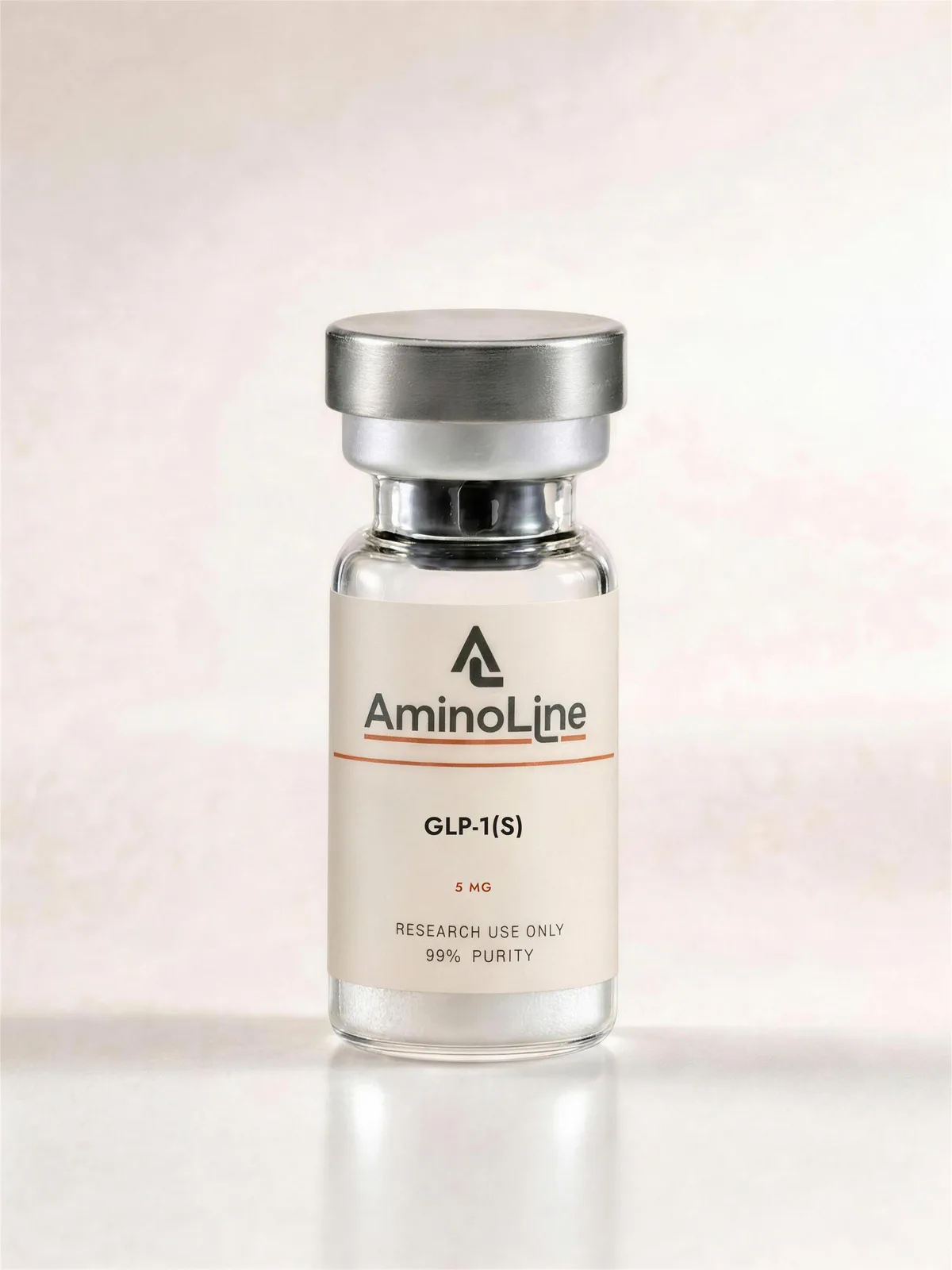
GLP-1(S) is a synthetic, chemically modified analog of glucagon-like peptide-1, studied in research as a long-acting agonist of the GLP-1 receptor (GLP-1R). Amino Line catalogues it as GLP-1(S) with CAS number 910463-68-2, a molecular formula of C187H291N45O59 and a molecular weight of 4113.58 g/mol. The compound is produced by solid-phase peptide synthesis combined with a post-synthetic lipidation step, and is supplied as a lyophilized powder for laboratory research use only.
The compound is built on the sequence of native GLP-1, with roughly 94 percent sequence homology to the endogenous GLP-1 7-36 amide fragment. Two deliberate chemical changes separate it from the native peptide: an alpha-aminoisobutyric acid (Aib) substitution near the N-terminus, and a C18 fatty di-acid side chain attached through a linker to a lysine residue at position 26. Those two edits account for most of what makes the molecule useful as a research tool, because they change how the peptide behaves in assay media, in the presence of proteases and in protein-binding studies.
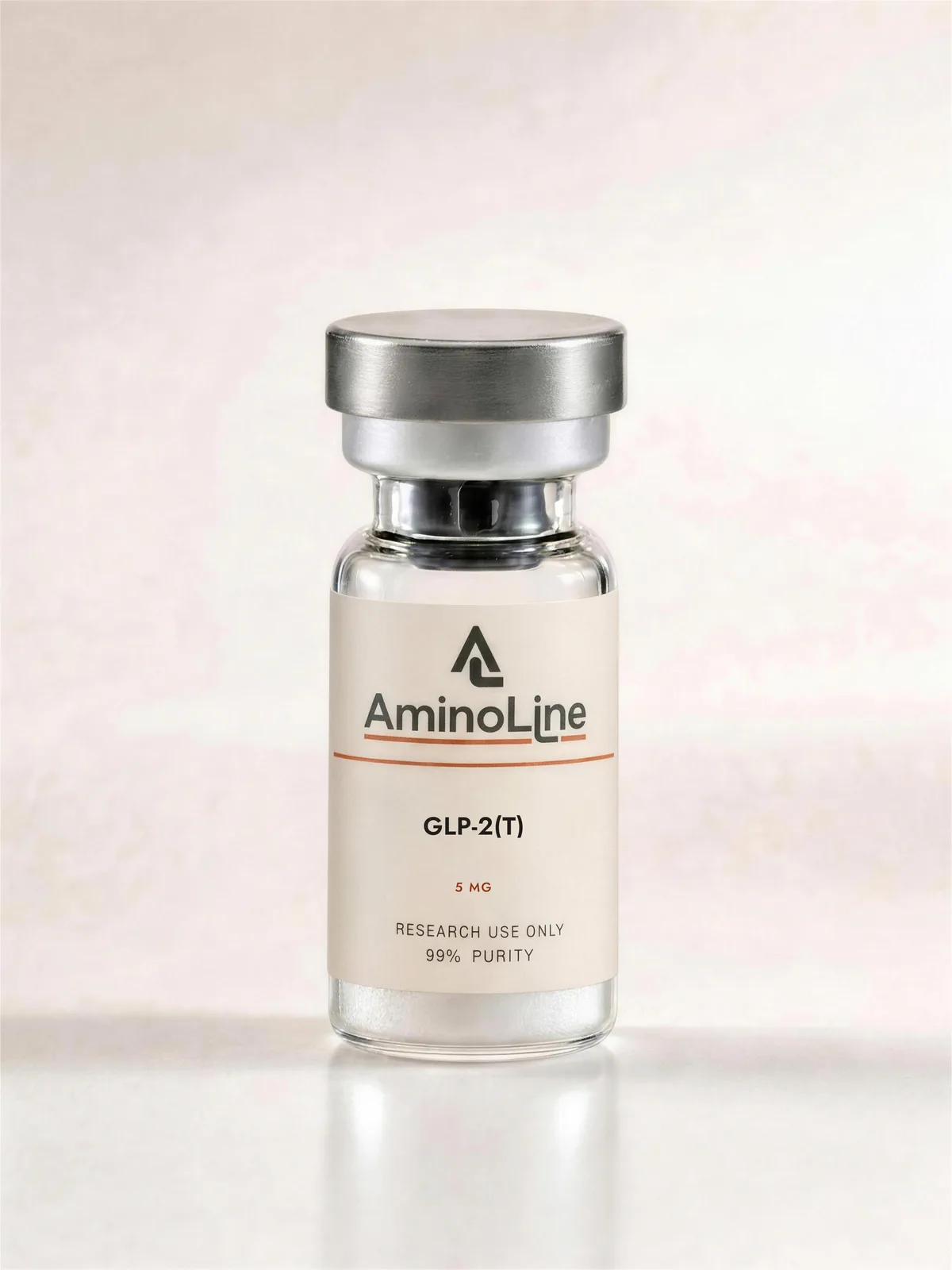
Within the Amino Line catalogue, GLP-1(S) sits in the incretin group alongside native GLP-1 and the multi-receptor compounds GLP-2(T) and GLP-3(R). Of the group it is the one most often used as a long-acting single-receptor reference, which is why a structural walkthrough is a good starting point for the family.
How does the GLP-1(S) sequence relate to native GLP-1?
Native GLP-1 is processed from proglucagon by prohormone convertases in intestinal L-cells and in a small population of brainstem neurons. The biologically active forms are GLP-1 7-37 and GLP-1 7-36 amide, both generated by removal of the N-terminal fragment. The native peptide is a roughly 30-residue helical hormone, and its short persistence in biochemical systems is the central practical problem researchers face when working with it.
GLP-1(S) keeps most of the native residue order, which is why it engages the same receptor binding pocket. The helical middle and C-terminal portions of the peptide contact the extracellular domain of GLP-1R, while the N-terminal region reaches into the transmembrane core and drives receptor activation. Published structural analyses of the receptor, including cryo-electron microscopy work on the active, G-protein-bound state, describe this two-step binding model in detail. Because the analog preserves the residues that matter for both steps, it is recognized by the receptor in a way comparable to the native ligand.
Where the sequence departs from native GLP-1 is therefore informative. Differences cluster at the N-terminal protease-sensitive site, at the lysine carrying the lipid chain and at a small number of conservative substitutions elsewhere in the helix. Researchers comparing the two molecules in binding or signaling assays can attribute differences in behavior to a short list of defined edits rather than to a wholesale redesign.
What does the Aib substitution do?
Native GLP-1 is cleaved rapidly by dipeptidyl peptidase-IV (DPP-IV), a serine protease that removes the first two N-terminal residues and converts the peptide to an inactive truncated form. The cleavage depends on the penultimate alanine at position 8 (numbering from the 7-36 form). Replacing that alanine with Aib, a non-proteinogenic amino acid carrying a second methyl group on the alpha carbon, sterically blocks the protease from recognizing the site.
The practical result in vitro is a molecule that persists in DPP-IV-containing media far longer than the native peptide. For a researcher this matters because it separates two questions that are otherwise tangled together: how a ligand engages the receptor, and how quickly the ligand is degraded in the experimental system. With the degradation question largely removed, signaling kinetics, receptor internalization and recycling can be measured without the confounding loss of ligand.
Aib is also a strong helix-promoting residue. Its presence near the N-terminus is generally discussed as having a modest stabilizing effect on local helical conformation, though the main documented contribution remains protease resistance.
How does the C18 fatty di-acid chain change the molecule?
The second modification is lipidation. A C18 fatty di-acid is attached to the lysine at position 26 through a short hydrophilic spacer. This side chain does not participate in receptor recognition in the usual sense. Its function is to bind serum albumin reversibly through the albumin fatty acid binding sites.
In pharmacokinetic model systems, albumin binding has two reported effects. It shields the peptide from enzymatic degradation, and it slows removal from the circulating compartment in animal models, so the effective persistence of the compound is measured in days rather than the minutes typical of native GLP-1. In cell-based work the same property shows up differently: media containing albumin will sequester part of the compound, shifting apparent potency. Researchers therefore need to report the albumin content of assay buffers, since potency values for lipidated peptides are strongly dependent on it.
The fatty di-acid also raises the molecular weight and changes the solubility profile of the peptide relative to native GLP-1. That is part of why the catalogued weight for GLP-1(S), 4113.58 g/mol, is well above the roughly 3.3 kDa of native GLP-1 at 3337.73 g/mol. Comparing the two catalogue entries side by side shows how much mass the modifications add.
What receptor signaling has GLP-1(S) been used to study?
GLP-1R is a class B G protein-coupled receptor. Agonist binding favors coupling to the Gs protein, activating adenylyl cyclase and increasing intracellular cyclic AMP. Downstream, cAMP engages protein kinase A and the exchange protein directly activated by cAMP (Epac) pathways, which have been characterized in pancreatic beta-cell lines, primary islet preparations and neuronal cultures that express the receptor.
GLP-1(S) is used in this literature as a long-acting reference agonist. Typical research applications described in published work include:
cAMP accumulation assays. Concentration-response measurements in receptor-expressing cell lines, used to compare potency and efficacy across analogs.
Receptor internalization and trafficking. Because the ligand persists, internalization and recycling kinetics can be followed over extended time courses with fluorescent or tagged receptor constructs.
Biased signaling studies. GLP-1R can couple to beta-arrestin as well as to Gs. Comparisons between ligands have been used to ask whether different agonists favor one pathway over the other, and the lipidated analog is a common comparator.
Receptor structure work. The molecule or close relatives have appeared as the bound ligand in structural studies of the receptor-G protein complex.
None of this describes an outcome in a living organism. The compound is a research tool for characterizing receptor pharmacology, and every application above sits in a cell, membrane or structural-biology setting.
How does GLP-1(S) compare with the other incretin compounds?
The incretin family in the catalogue spans a progression of receptor targets. Native GLP-1 engages GLP-1R only and is rapidly degraded. GLP-1(S) engages GLP-1R only but is protease resistant and albumin binding. GLP-2(T) is a longer peptide built on a GIP-derived backbone that engages both the GIP receptor and GLP-1R, and GLP-3(R) adds glucagon receptor activity for three-receptor engagement.
For a researcher this creates a natural experimental ladder. A single-receptor, long-acting agonist like GLP-1(S) provides the baseline. Adding a second or third receptor arm lets the contribution of each receptor to the overall cAMP response be separated. Using native GLP-1 alongside it separates the contribution of persistence from the contribution of receptor engagement. Without a clean single-receptor comparator, results from multi-agonist compounds are difficult to interpret, which is why GLP-1(S) is often described as the reference point of the group.
What should researchers know about purity, identity and handling records?
Catalogued purity for GLP-1(S) is 99 percent or higher by HPLC, with identity confirmed by mass spectrometry. For a lipidated peptide of this size the mass spectrum is a useful identity check because the observed mass reflects both the backbone and the attached side chain; a deviation points to incomplete lipidation or truncation products. Storage in the catalogue is listed as lyophilized at -20 °C.
Good research practice with a compound of this kind means keeping lot-specific analytical records, noting the albumin and protein content of any assay buffer, and documenting freeze-thaw history of stock material in the lab record. Lipidated peptides can adsorb to plastic surfaces, so labware choice and carrier protein are details worth recording when potency values are going to be compared between laboratories or between lots.
Why is a classic structural approach useful here?
Amino Line focuses on compounds whose structure and mechanism are well documented. GLP-1(S) fits that profile because each of its features can be traced to a specific edit: Aib for protease resistance, a C18 fatty di-acid for albumin binding, and a conserved helical core for receptor recognition. A researcher reading the published structural and pharmacological literature can map almost every observed behavior to one of those three features, which is the kind of mechanistic clarity that makes a compound a good reference tool rather than a black box.
Research use disclaimer
GLP-1(S) is supplied strictly for in vitro laboratory research and analytical use. It is not a drug, dietary supplement or consumer product, and it is not intended for human or veterinary use. Nothing in this article describes or recommends any use outside qualified laboratory research. For research purposes only.