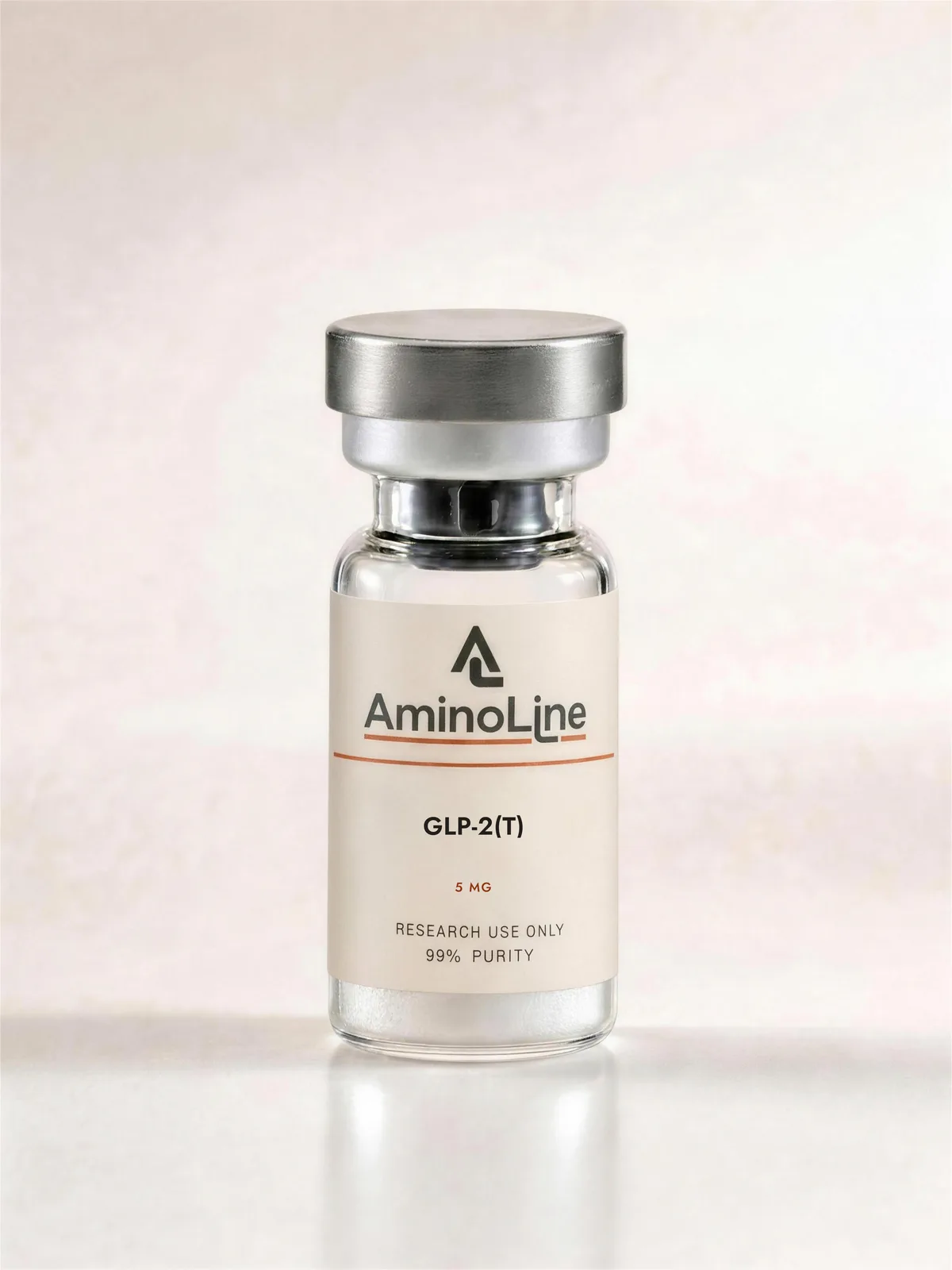
Tirzepatide is a synthetic 39-amino-acid peptide studied as a co-agonist at two incretin receptors, the glucose-dependent insulinotropic polypeptide receptor (GIPR) and the glucagon-like peptide-1 receptor (GLP-1R). In the Amino Line catalogue it is listed as GLP-2(T) (Tirzepatide) with CAS 2023788-19-2, molecular formula C225H348N48O68 and a molecular weight of 4813.53 g/mol. It is a research material for laboratory use only.
The compound is built on a GIP-based backbone and carries two engineered features: Aib substitutions at positions 2 and 13, and a C20 fatty diacid chain on Lys20. Both are covered below. This overview describes structure, receptor pharmacology and the published trial landscape, and it draws no conclusions about outcomes.
What is the molecular structure of tirzepatide?
The catalogue entry describes tirzepatide as a 39-amino-acid peptide with a formula of C225H348N48O68 and a molecular weight of 4813.53 g/mol. The backbone follows the GIP sequence, with changes introduced so that the molecule can also engage the GLP-1 receptor. The structure combines a linear peptide chain with a lipid side chain, so it is a hybrid of peptide and fatty-acid chemistry.
Two kinds of modification are described. Aib, or aminoisobutyric acid, is a non-proteinogenic amino acid that replaces native residues at positions 2 and 13. Substitution near the N-terminus is described as providing resistance to cleavage by dipeptidyl peptidase IV (DPP-IV), an enzyme that removes the first two residues of native incretin peptides. The second modification is a C20 fatty diacid attached to Lys20 through a linker, described as supporting albumin binding and a prolonged biochemical half-life in model systems.
Because the molecule has both a long peptide chain and a conjugated lipid, its analytical characterization is more demanding than for short heritage fragments. Identity and purity are normally confirmed by HPLC and mass spectrometry on the full lipidated species.
How does tirzepatide relate to the native incretin peptides?
Tirzepatide is a designed analog and not a native hormone. The native incretins are GIP and GLP-1, both secreted from the intestine. Both are released in response to nutrients and both act through class B G-protein-coupled receptors. Native forms have short half-lives in biological systems because DPP-IV removes their N-terminal residues.
Tirzepatide takes the GIP sequence as its template and adjusts residues so that the same molecule can also activate GLP-1R. That is the sense in which it is called a dual or co-agonist. The Aib substitutions and the lipid side chain address the two weaknesses of the native peptides in experimental work, namely enzymatic cleavage and rapid clearance.
Researchers interested in the single-receptor reference compounds can compare it with the single-receptor GLP-1 class compound described in the Amino Line GLP-1(S) research overview. That article keeps the same separation between structural facts and published findings.
What receptor pharmacology is described for tirzepatide?
Tirzepatide is described as an agonist at both GIPR and GLP-1R. Each is a Gs-coupled class B receptor, and activation raises intracellular cAMP, which is the usual readout in cell-based assays. Studies of this kind are typically run in cell lines expressing one receptor at a time, in pancreatic beta-cell models, and in adipocyte preparations where GIPR is expressed.
A point often noted in the pharmacology literature is that the molecule is not simply a one-to-one mixture of two agonists. Published characterization work reports that its relative activity at the two receptors differs, and that the way it engages each receptor differs from the way the native hormones do. These are descriptions of in vitro behavior, and they should be read with the assay system in mind, since cell type, receptor density and readout all affect the numbers.
For a researcher, the practical point is that the compound is a tool for combinatorial incretin signaling studies. It allows both receptors to be engaged by a single defined molecule, which a pair of separate single-agonist reagents does not replicate exactly.
How does tirzepatide compare with related incretin-class compounds?
Tirzepatide sits between single-receptor and multi-receptor incretin analogs. The table below lists the receptor targets as described in the catalogue entries, and it makes no statement about relative performance.
The catalogue lists GLP-3(R) as a triple receptor agonist, which adds the glucagon receptor to the two engaged by tirzepatide. Cagrilintide belongs to a different receptor family altogether, the amylin and calcitonin receptor complex, and is covered in its own overview at Cagrilintide: Molecular Structure and Research Overview. Grouping these compounds by receptor target, not by name, is the clearer way to organize a literature review.
What does the published trial landscape look like?
Tirzepatide has been the subject of a large clinical development program, and the trials are public. The literature describes them as named series, including the SURPASS program and the SURMOUNT program, each made up of several studies. Those studies are described in the primary publications and in registry entries, and this overview does not summarize or interpret their results.
What can be said as a matter of description is how the literature is organized. Reports in these programs vary in design, comparator, population and duration, so findings from one study should not be carried over to another without checking the design. Researchers reading the trial literature are usually advised to record, for each report, the study name, the comparator and the stated endpoints, and to separate what the authors reported from what secondary commentary says about it.
None of this bears on laboratory research material. The catalogue compound is supplied for in vitro research, and trial publications concern a separate regulated product and context. Amino Line makes no outcome claim, no dosing statement and no suggestion of use, and the trial landscape is mentioned only so that a reader knows where the primary literature sits.
How should tirzepatide research material be documented?
Documentation for a compound like this has three layers. The first is the structural record: the catalogue lists 39 residues, formula C225H348N48O68, molecular weight 4813.53 g/mol and CAS 2023788-19-2. These should be copied from the catalogue entry for the specific form in hand. The second is the literature record, with key papers described in prose and dated. The third is the lot record, which includes the supplier's HPLC and mass spectrometry data.
Keeping the layers separate prevents a common error. A well-characterized structure does not make a biological claim true, and a published report about a regulated product does not tell a researcher anything about whether a given vial matches its specification. Each layer is checked on its own terms, and discrepancies between the catalogue values and the certificate of analysis are raised with the supplier before work begins.
Research use disclaimer
All compounds mentioned in this article are discussed as laboratory research materials only. They are not drugs, dietary supplements or consumer products, and nothing here is intended as guidance for human or veterinary use. Statements about published findings should be confirmed against the primary literature. For research purposes only.
Reference
Common questions
Tirzepatide is a synthetic 39-amino-acid peptide studied as a dual agonist at the GIP receptor and the GLP-1 receptor. It carries Aib substitutions and a C20 fatty diacid on Lys20. In the catalogue it is listed as CAS 2023788-19-2 with formula C225H348N48O68. For research purposes only.
The Amino Line catalogue lists tirzepatide with a molecular weight of 4813.53 g/mol and a molecular formula of C225H348N48O68, under CAS 2023788-19-2. Researchers should copy these values from the catalogue entry and cross-check them against the certificate of analysis for the specific lot.
Tirzepatide is described as engaging both the glucose-dependent insulinotropic polypeptide receptor (GIPR) and the glucagon-like peptide-1 receptor (GLP-1R). Both are Gs-coupled class B receptors, so signaling is studied through cAMP readouts in cell and tissue models. The peptide backbone is described as GIP-based.
Published trial programs are named and described as reported in the literature, without outcome claims from Amino Line. This overview does not interpret results, and it does not give dosing or administration information. Readers should consult the primary trial publications directly. Material is sold for laboratory research only.